Tuesday, December 5, 2017

Research-Informed Teaching of Adults: A Worthy Alternative to Old Habits and Hearsay?

Research-Informed Teaching of Adults: A Worthy Alternative to Old Habits and Hearsay?
John Benseman
Dept. of Education


Research informed teaching (RIT)

1. research-led, where the curriculum content is based on the research interests of teachers
2. research-oriented, where the process of learning content is seen as important as the content itself and hence, an emphasis on learning inquiry skills
3. research-based, where the curriculum is based on inquiry-based activities rather than acquisition of content
4. research-informed teaching, which consciously draws on systematic inquiry into the teaching and learning process itself.
It is the last of these four, research-informed teaching, using relevant research findings to shape and re-shape our own teaching, that is the focus of the article.

interesting quote
"Teaching is a surprisingly private affair, where the main audience of learners tend to only relate what they witness anecdotally and without the benefit of appropriate analytical tools."
As Guernsey and Ochshorn (2011, p. 1) observed, “often these activities take place out of sight, witnessed only by principals or directors taking stock of a teacher’s skills, sometimes based on no more than a few jots about what they see from the doorway.”


A second finding in these studies is that these teaching techniques did not relate very well with current research findings. Brown (2004, p. 1) suggests that teachers’ reliance on what they have experienced rather than research findings is due “in large part because many have had little education about and understanding of adult learning principles.”

Although teachers’ responses in their interviews suggested they wanted to be learner-centered, our classroom observations quite clearly showed that instruction was highly teacher-directed. If teachers controlled the classroom, and they intended to be learner-centered, how could a teacher-directed system of instruction result? Our answer harks back to the concept of socialization. We concluded that teachers are so intensely socialized into a teacher-centered form of instructing that they teach in teacher-centered ways, despite intentions to be learner-centered (2001, p. 110).

A second approach is to draw on learners’ perspectives on what they see as effective teaching/teachers. These studies survey large samples of learners about what they believe helps them learn most effectively. They can identify particular characteristics (such as the ethnicity or gender of the teacher), their teaching behaviours (such as specific teaching methods) or their learning environment (such as various aspects of logistics in educational settings) that learners identify as helping them learn. They can also focus on general groups of learners or specific sub-groups, such as the unemployed (Benseman, 2001), literacy learners (Ward, 2003), refugees (Benseman, 2012a) or different cultural groups (Pratt et al., 1999), which gives these studies a specialist slant to their findings. This approach is also commonly employed in national and institutional ‘best teacher’ awards.

Learner-driven studies are particularly useful for showing us what learners value and are therefore probably useful for telling us what factors are likely to increase their participation rates and retention for example, but they also have their limitations. The difficulty with this approach is that learner ratings (typified in smiley-face type evaluation sheets) do not necessarily indicate learner impact in its entirety as measured in other outcome indicators

A third alternative is to refer to ‘practitioner wisdom’ of teachers who are perceived to be effective by their peers. These accounts are often insightful and useful (see for example, Nugent, 2011), but may or may not match the relevant research.

Another alternative to those discussed above is that of research-informed teaching (RIT) or its near-cousins, research-informed practice and research-based practice.

The paucity of research in other sectors inevitably means that inclusion criteria for RIT need to be relaxed somewhat to ensure reasonable numbers of studies. In the absence of research volume, or even with questionable quality research, it is argued that that even “imperfect evidence, used wisely, is better than no evidence at all” (Spencer et al., 2012, p. 136).

In sum, the quality of RIT evidence is ensured by accessing peer-reviewed literature (irrespective of its ontology), duplication and consensus of results (the degree to which there is agreement in the research about the findings) and “ultimately a preponderance of quality evidence gathered in rigorous research studies” (Stanovich & Stanovich, 2003, p. 6).

Notwithstanding major paradigm shifts, research-informed practices have a far greater chance of standing the test of time and leading to improvements in outcomes and ultimately better professional performances.
Teaching is a complex activity, involving the interplay of multiple factors in multifarious contexts. It is also involves creativity and even a certain amount of X factor that can never be quite isolated or nailed down to an analytical floor. But it also involves multiple components about which we have an increasing body of good quality research. Although the research evidence is rarely clear-cut or irrefutable, it does provide a sturdier platform to base our teaching than the alternatives of old habits and hearsay. The challenges lie in assembling the ‘preponderance of research evidence’ to inform teaching practices, to present it in forms that practitioners can understand and utilise and then to develop strategies that help teachers integrate it into their daily work with learners. Rising to these challenges is neither straightforward nor easy, but achieving it will almost certainly provide more

Wednesday, November 29, 2017

Week 3 in class sessions

SAMR:  SAMR model


TPACK:  3 knowledge areas
Tpack explained


"Distruption in Education"
The more overdue a disruption is, the more sudden it is when it finally occurs, and the more-off guard the incumbents are caught"

The rise of the "celebrity teacher"  is entirely possible


Technology disruption

Saturday, November 25, 2017

Preparing for Week 3: Leadership

Conditions for classroom technology innovation


Big question:
"why don't teachers innovate when they are given computers?" rather than whether computers can improve student learning.

Three factors associated with the teacher have
been found to contribute significantly to the success of classroom technology innovations: technology proficiency, pedagogical compatibility, and social awareness.


Innovation:  Distance refers to how much the innovation deviated from the status quo. We found distance to be important in three areas: distance from the existing school culture, distance from existing practice, and distance from available technological resources. Dependence refers to the degree that an innovation relies on other people or
resources—particularly people and resources beyond the innovator’s immediate control.

The study found that a supportive school environment is important for
successful technology integration. Teachers need access to a healthy human

infrastructure and a functional and convenient technical infrastructure.

Wednesday, November 22, 2017

3 problems, challenges, frustrations

 1.. Barriers to engaging whanau in learning relationships

2. No shared expectations of learning with whanau

3. Portfolios in the juniors being  highly teacher controlled

4. teachers not having enough contact with whanau

5. Conversations  with parents being mainly about behaviour.

6. How do we raise teacher capability with ICT

7. How do we include more parents voice in our curriculum


How these relate to 21st century skills and Key competencies

A positive digital footprint

"I can see a day not too far in the distant future (if its not already here) where your digital footprint will carry more weight than your CV.


Week 2 preparation: Digital


Change is uncomfortable not hard.

Schools are becoming adaptable, relevant, self correcting, Creative spaces,

Cognitosphere: System of knowledge creation


John DEWEY: He had it right. Told us correctly nearly 100 years.

"if we teach today as we did yesterday, we rob our children of tomorrow"

What we need to do:
Teach into the unknown
Self evolving learning

Preparing our students for their future, not our past.


Saturday, November 18, 2017

Leadership: Preparing for Week 2

Click here for Towards Reconceptualising Leadership: The Implications of the Revised New Zealand Curriculum for School Leaders


Wayne Freeth University of Canterbury, Christchurch, New Zealand with Vanessa de Oliveira Andreotti University of Oulu, Finland
This case study explores the challenges for school leadership posed by the New Zealand Curriculum (NZC) (2007), and investigates some implications for practice. The study is situated within the wider Teaching and Learning Research Initiative (TLRI) project, ‘Shifting the Conceptualisation of Knowledge and Learning in the Integration of the New New Zealand Curriculum in Initial and Continuing Teacher Education’ (Andreotti, Quinlivan, & Abbiss, forthcoming) which examines shifts in educators’ understandings of knowledge and learning in the implementation of the NZC in nine settings within initial and in-service teacher education.
The theoretical framework of this project draws on the work of Gilbert (2005) with reference to the ‘knowledge society’. Gilbert challenges long-held views about education and knowledge, making a distinction between knowledge conceptualised as a noun and a verb. In her outline of the differences, knowledge conceptualised as a verb is something we do something with, rather than something we have; it is linked with performativity rather than truth, and it is more like an ‘energy’ than building blocks that can be accumulated. This has several implications for the area of leadership. Knowledge conceptualised as a noun tends to enable autocratic and bureaucratic styles of leadership, while knowledge conceptualised as a verb may enable democratic, distributed and transformational styles of leadership, which are necessary for the effective implementation of the NZC, particularly in terms of the principles of inclusion and community participation in the co-construction and the co-ownership of the curriculum. Another important aspect of the NZC that is emphasised by the conceptualisation of knowledge as a verb is the role of teachers as leaders in the construction of the curriculum and in responding to the needs of diverse students.

My reflection:
I agree that I see teaching as a verb not a noun. A noun inplies i have the knowledge and it must be passed to the students. Wheras the idea it is a verb inplies that it is something we do, co-construct with the children. That is the design of our curriculum in Te Waahi. Furture focused pedagogy.
I agree with Wynne (2001) who has a definition of teacher leaders. This definition shows that all teachers are leaders in their class. They question and challenge, they share knowledge, frequently reflect on what they are doing and is it on the cutting edge. We see Vanessa and samdra in Te Waahi doing this. They are role models for the other areas of the school. These teacher leaders "are risk takers who participate in school decisions"  Our challenge at Tuakau School  is how do we get all the staff opportunities to take these risks. What do we need to take away to allow this?
Looking at table 1:
Table 1 Summary of characteristics of principals who promote teacher leadership

Make space for individual innovation Create opportunities for individual expression; encourage identification of – and confrontation of – institutional barriers and 
Know when to step back Demonstrate trust; illuminate how power can and should be distributed; acknowledge the importance of the individual professional; attest to the central place of teaching in school decision-making

This is what was done by leadership on our TOD. Teachers were asked to smash the ceiling. To try in term 4 innnovative things and we would take some of the barriers away like the National Standards pressure. We want teachers to feel like they are leaders in their classrooms and they can explore, trial and innovate. 
What we still need to work on though is "Pose difficult-to-answer questions. Heighten the level of professional dialogue about educational practices; encourage individual commitment from alienated teachers" 
This is important because we have teachers that are alienated and we need to question the practices, find out if they understand the research and reasons behind decisions. Do they fully understand the vision for Tuakau School. Has the strategic direction been clearly expressed??


I love this table and think it could be used to unpack this concept with staff and  to reflect on where we are currently in terms of this.

The characteristics of ‘communicating a strategic intent’ and ‘knowing when to step back’ (Crowther et al., 2002) emerged in the notion that ‘anyone can be a leader’ in the school, although notions of control and regulation (based on expert or hierarchical authority) could still be simultaneously present: The role of the principal is pivotal. As Viviane Robinson research suggests, where the Principal takes and leads PD …. there is a big impact [Robinson, 2007]. The principal must be empowering and give opportunities to the middle leaders. Someone with no position of leadership can step up and take a role. The principal does not need to be the font of all knowledge but needs to be familiar enough to direct staff. The principal needs to ensure there is a strong evidence base to teacher’s work and decision making. The principal has a role to stand on the balcony and to look further out (not as a superior) … to take time and reflect and look to the horizon while other teachers are busy with business as usual . . . and see what is ahead . . . what the next move is going to be (Principal 3, interview 2) pg 12

I have been reflecting on this paragraph. "The principal needs to ensure there is a strong evidence base to teacher’s work and decision making." This is something I want to talk to teachers about in their appraisal meetings this week. I want to discuss  what evidence base they have for some of the decisions they have made in their classroom" Why are they doing maths a particular way in their classroom etc"


Leadership

Image result for sheep


Followership Styles
Kelley (1998) identifies two ways that people follow: 
  1. Do they think for themselves? Are they independent critical thinkers? Or do they look to the leader to do the thinking for them? 
  2. Are they actively engaged in creating positive energy for the organization? Or is there negative energy or passive involvement? 
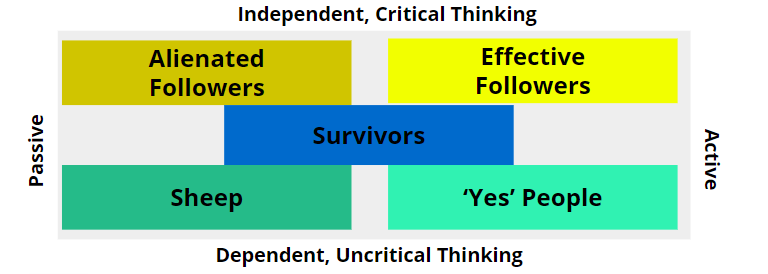
Based on his two dimensions, Kelley found these five basic styles of followership.  
  • Sheep are passive and look to the leader to do the thinking for them and to motivate them. If you are the boss and in your car on the way to work, and you’re thinking about what you’re going to get your workers to do and how you’re going to do that, then you’re dealing with sheep.
  • Yes-people are positive, always on the leader’s side, but still looking to the leader for the thinking, the direction, the vision. If the leader asks them to do something, they’ve got the energy, and they’ll go forward with it. When they finish that task, they’ll come back to the leader, asking, “What do you want me to do next?” However, yes-people don’t see themselves this way. One of the things I’ve learned is that the different styles of followers will almost always put a positive spin on their style. Yes-people will say, “I’m a doer; that’s my job. The boss gets paid to think, and I’m the one who does the work.” But the rest of us would say there’s more to being a good follower than simply doing.
  • Alienated followers think for themselves, but have a lot of negative energy. Every time the leader or organization tries to move forward, these are the ones who have ten reasons why the leader or organization shouldn’t. They are not coming up with the next solution, but are skeptical, cynical about the current plan of action. They have energy, they can think for themselves, they can be smart. But they are not moving in a positive direction. However, they see themselves as the mavericks, the only people in the organization who have the guts to stand up to the boss.
  • Survivors sit on the fence and see which way the wind blows. Once they see where things are headed, they’ll get on board. They’ll never be the first on board, but they will never let the leader or organization leave without them. They see themselves as preservers of the status quo. Their internal dialogue goes something like this: “If I got all excited every time there was a new leader or a change of direction, my wheels would be spinning constantly. Leaders come and go. New visions come and go. If I just sit here and wait it out, I won’t have to do all that work.” So they do what they must to survive, but wait it out until the storms of change blow over.
  • Effective followers think for themselves, are very active, and have very positive energy. They do not accept the leader’s decision without their own independent evaluation of its soundness. If they agree with the leader, they give full support. If they disagree, they challenge the leader, offering constructive alternatives that will help the leader and organization get where they want to go. Some people view these people as really “leaders in disguise,” but this is basically because those people have a hard time accepting that followers can display such independence and positive behavior. Star followers are often referred to as “my right-hand person” or my “go-to person.”
A Continuum Between Leadership and Followership
Leadership and followership are, of necessity, closely related to one another. Hollander (1992) notes that "the role of follower can be seen as holding within it potential for both assessing and taking on leadership functions. In addition to directing activity, these include decision making, goal setting, communicating, adjudicating conflict, and otherwise maintaining the enterprise". Crippen (2012) makes a further point, that not only do followers take on leadership functions, but that these roles are not fixed. “If a school is truly developing and growing and learning and is collaborative, then each person is leader and follower at various times.” 
These leadership definitions have made me reflect on our roles in our leadership team. We are very lucky at Tuakau School as we have Effective followers on our leadership team. We have built a culture where each member of the leadership team feels safe to ask questions and challenge and find out all the information and offer alternatice suggestions. 
Our challenge is that we have 3 or 4 alienated followers and we have to examine how we get them to become effective followers. Providing research and reasons for decisions can help. 

Carsten, M. K., Uhl-Bien, M., West, B. J., Patera, J. L., & McGregor, R. (2010). Exploring social constructions of followership: A qualitative study. The Leadership Quarterly, 21, 543–562.
Crippen, C. (2012). Enhancing authentic leadership− followership: Strengthening school relationships. Management in Education, 26(4), 192-198. 
Hollander, E.P. (1992). The Essential Interdependence of Leadership and Followership. Current Directions in Psychological Science, 1(2),71-75.
Kelley, R. (1988). In praise of followers. Harvard Business Review, 66(6), 142–148.

Wednesday, November 15, 2017

First night

Thursday 16th November was our first night

Photo

What is the purpose of education:

 “Our job as teachers and parents is not to prepare students for something; our job is to help students prepare themselves for anything.” (Juliani, n.d.).
Juliani, A.J. (n.d.). What I’m Working On Right Now. Retrieved from http://ajjuliani.com


My inspirational quote:
“Many ideas grow better when transplanted into another mind than the one where they sprang up.

‘The fact is that given the challenges we face, education doesn’t need to be reformed - it needs to be transformed. The key to this transformation is not to standardise education, but to personalize it, to build achievement on discovering the individual talents of each child, to put students in an environment where they want to learn and where they can naturally discover their true passions” (Robinson, 2009)

This quote resonated with me as I believe we do need to personalise education, we neeed to make connections with our students and discover the individual talents of the children and work with those students so they can finbd out what they are passionate about and use this to integreate their learning into.

The Greek word, ‘episteme’, refers to knowledge, and epistemology tries to identify the essential, defining components of knowledge. The Stanford Encyclopedia of Philosophy (SEP, 2017a) is one of the sources explaining that knowledge is a justified true belief. That source itself is an interesting one from the knowledge perspective since SEP has been designed so that each entry is maintained and kept up-to-date by an expert or group of experts in the field. All entries and substantive updates are refereed by the members of a distinguished Editorial Board before they are made public.
Purpose of Education
Biesta (2005) helps us to a wider view of education by focusing on the question of purpose – putting the ‘why’ of education before the ‘how’. He suggests three broad domains of educational purpose, illustrated in the diagram below by Phillipson (2014).
Is this model the same over the word? Do all education systems put the same value on qualifications etc.


Goals for Maori Education
In February 2001 the first Hui Taumata Mātauranga provided a framework for considering Māori aspirations for education. It resulted in 107 recommendations based around the family, Māori language and custom, quality in education, Māori participation in the education sector and the purpose of education. There was also wide agreement about three goals for Māori education:
  • to live as Māori
  • to actively participate as citizens of the world
  • to enjoy good health and a high standard of living
(Durie, 2004).
How is this different to Biesta's model of education? To live as Maori is different. This is what we need to unpack at Tuakau School. What does this mean for our parents and whanau.
Biesta, G. (2015). What is education for? On good education, teacher judgement, and educational professionalism. European Journal of Education, 50(1), 75-87.
Juliani, A.J. (n.d.). What I’m Working On Right Now. Retrieved from http://ajjuliani.com
Phillipson, N. (2014). Biesta, the Trivium and the unavoidable responsibility of teaching. 21st Century Learners. Retrieved from http://21stcenturylearners.org.uk/?p=492
Robinson, K. (2009). The Element: How Finding Your Passion Changes Everything. Penguin.


Saturday, July 1, 2017